Wednesday, May 2, 2012

Don't Forget Me Istanbul

By Artsvi Bakhchinyan
The name Eric Nazarian is not unknown to Armenia’s film audiences. For three years, from 2008-10, the Armenian American film director participated in the Golden Apricot International Film Festival in Yerevan. His first feature film as writer-director, “The Blue Hour,” was awarded four prizes in 2008: the Golden Apricot for Best Film in the Armenian Panorama, the Ecumenical Jury Award, the Prime Minister’s Award, and the Diaspora Ministry’s Special Award for Directing.
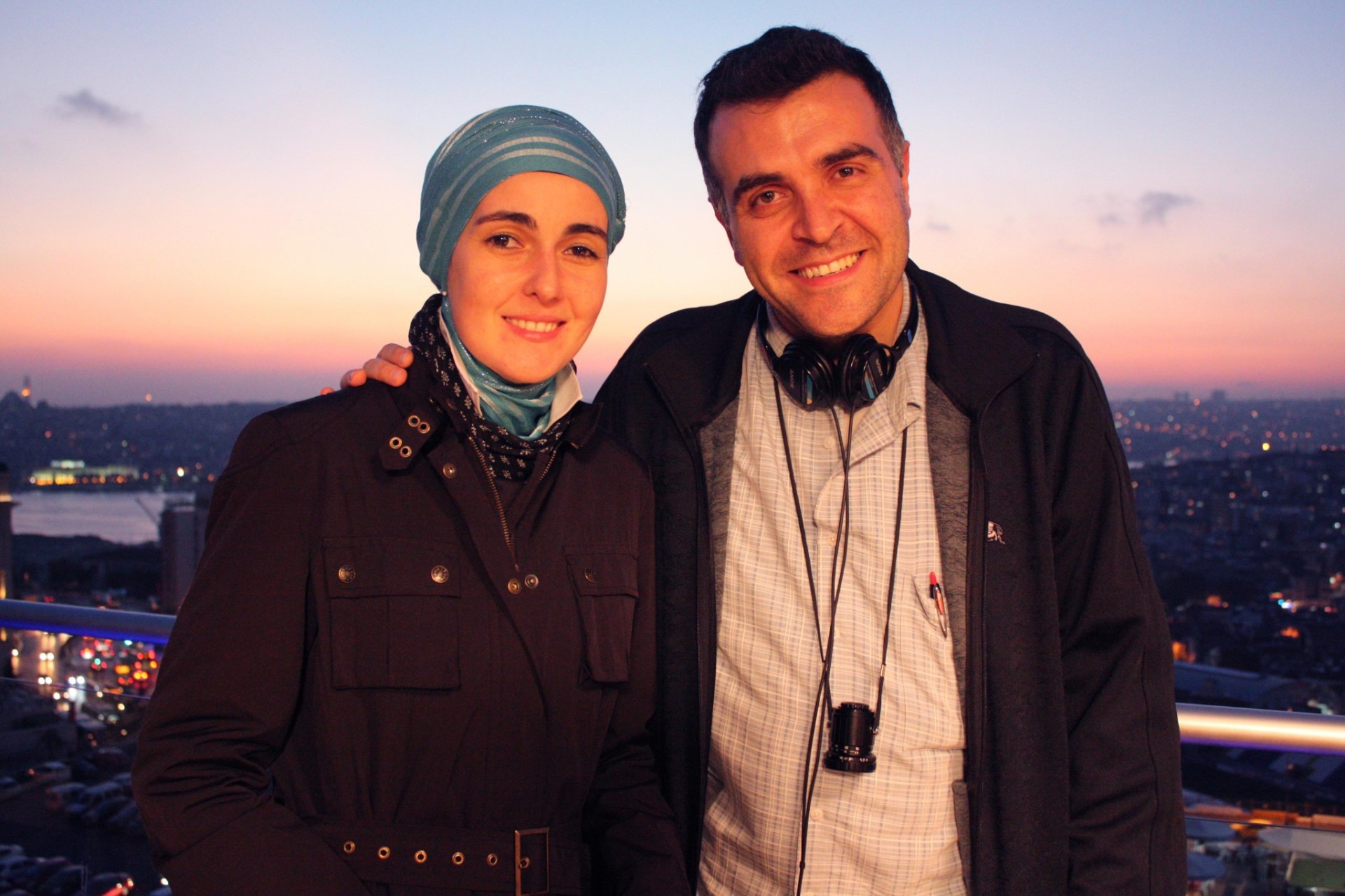
Filmmakers Eric Nazarian and Aida Begic on the set of BOLIS 300x200 How an Armenian Filmmaker Got the ‘G Word’ in a Turkish Movie
Filmmakers Aida Begic and Eric Nazarian on the set of 'Bolis'
It was a nice surprise to learn that Nazarian’s next movie has been made in Turkey, as part of an international omnibus project called “Do Not Forget Me, Istanbul.” The film premiere took place at the Istanbul Film Festival last April and is currently on the festival circuit. In the film, seven different filmmakers present some scenes from the life of the various ethnic minorities of Istanbul. Josephina Markarian, a Greek Armenian currently living in Istanbul, also joined the project. Nazarian, who was born in Armenia and has lived in the U.S. since he was a child, presents a personal story of his compatriot who is the descendant of one of the oldest communities of the city on the Bosphorus. In 18 minutes, Nazarian’s film, entitled “Bolis,” captures the everyday life, conversations, and brief encounter between a Diasporan Armenian musician, Armenak, and a Turkish widow. Through their encounter, the tragic history of one nation is unraveled through Armenak’s story.
Theirs is a simple story reminding us about the presence of the past within the modern-day psyche of Armenians worldwide and the responsibility of the inheritors on both sides to speak openly about a history that has been buried but refuses to be forgotten. Below, my conversation with Nazarian reveals some aspects of this unprecedented Armenian-Turkish cooperation.

Artsvi Bakhchinyan:
Eric, nowadays news of Armenian-Turkish collaboration doesn’t surprise one as it used to. But how did you come to join this project?
Eric Nazarian: My friend Cigdem Mater introduced the project to me. Huseyin Karabey, the producer, invited me to participate in the omnibus. The theme of what we remember and what we force ourselves to forget is important for me as an Armenian and as a filmmaker. The goal of the project that was initially pitched to me was to remind Istanbul through these films of the past cultures that contributed to what the city is today. These past cultures have over time been “forgotten,” hence the title “Do Not Forget Me, Istanbul.” I felt my story of Armenak’s journey to Bolis (Istanbul) fit thematically. The film is based on my feature screenplay “Bolis,” which follows Armenak from Los Angeles to Istanbul to find his grandfather’s oudshop and a family heirloom that disappeared during the Armenian Genocide.
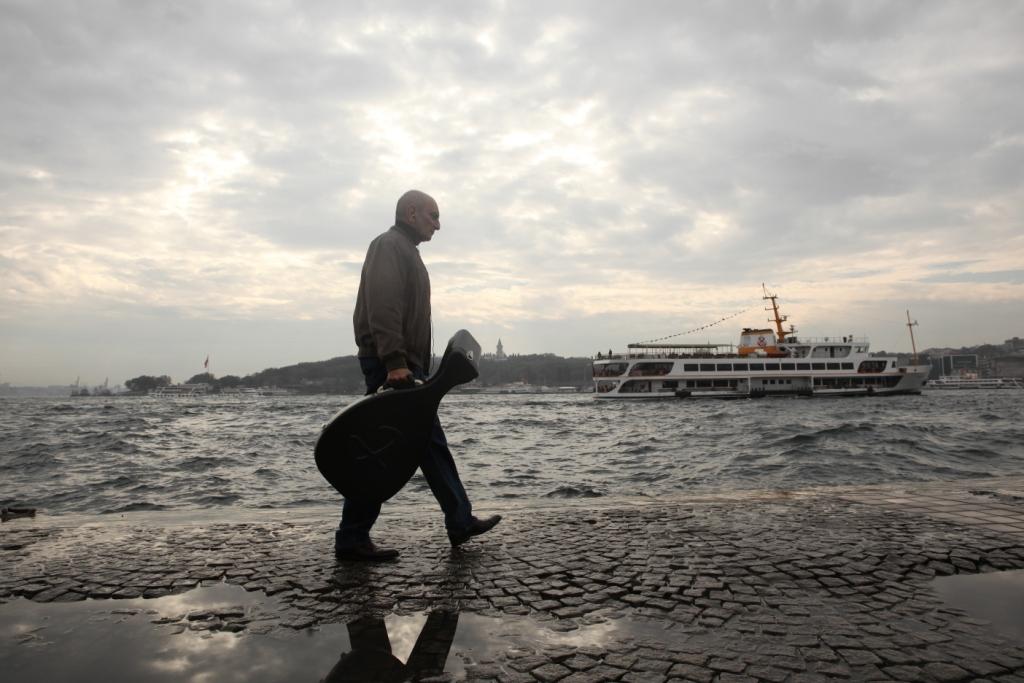
Writer Director Eric NAZARIANs BOLIS Still photograph of Jacky NERCESSIAN 300x200 How an Armenian Filmmaker Got the ‘G Word’ in a Turkish Movie
Nazarian's Bolis (Photo by Jacky Nercessian)
A.B.: You were born in Armenia, your parents came from Iran, now you live in the U.S. What is Armenian Bolis for you?
E.N.: When I was a child, I went to American school on weekdays and Armenian school on weekends. Everything I learned about cinema, literature, and art I owe a tremendous gratitude to my beloved father Haik, aunt Parik, uncle Haso, and my entire family who raised me to appreciate the cultures and arts of all nations. My first recollection of this term “Bolis” is from my beloved grandfather Hovhannes who would tell me these beautiful and textured stories of all the writers and poets of Constaninople, as Istanbul was called in the days of black and white Daguerrotype photographs. He introduced me to Daniel Varoujan, Siamanto, Krikor Zohrab. My aunt Parik introduced me to Gomidas Vartabed. My father Haik, who was a photographer, introduced me to the timeless images of Ara Guler. My grandfather, father, and aunt taught me about the amazing Armenian heritage and culture of Bolis. When I went back to make my film, I wanted to pay tribute to this world of “Old Bolis” through music because cinema is an audiovisual medium. For me, cinema is my wife. Music is my mistress. The music of Udi Hrant Kenkulian is the essence of Istanbul Armenian blues. What Ray Charles was to soul and blues, Udi Hrant is to Armenian/Turkish music: a true legend. When I first heard him in college, I didn’t know he was blind. When I read more about his life, his music resonated with me even more. “Srdis Vra Kar Muh Gah” is every bit as pure and powerful as the great blues spirituals of the Mississippi Delta of the ’30s and ’40s. The first day I docked in Istanbul, I told my assistant to take me straight to the Sisli Armenian Gregorian Cemetery, where I visited Udi Hrant’s family plot and later shot a pivotal scene in the film. It was an honor and deeply humbling to be standing by the ground where he rests.

A.B.:
I completely agree with your hero, that Istanbul is a kind of opium. That city is very addictive.
E.N.: Istanbul for me is a paradox and a mystery. It’s an onion I peeled everyday knowing I would never get to its core. The city is too complex and full of so much history. I’m not sure if it is possible to uncover even a fraction. I arrived in Istanbul with extremely mixed emotions. When the plane docked, my mind fluttered with all the images of Armin Wegner and the archive photos of the Near East Relief during the time of the genocide: the deportations, Gomidas, Siamanto, Daniel Varoujan, and all the intellectuals and members of society arrested on that awful day [April 24, 1915]. I arrived tensed up and angry, but thanks to my friends and Bolsa-Hyes [Istanbul Armenians], I soon realized that a part of my cultural DNA truly hails from there. There are certain streets in Istanbul that inspired an extremely uncanny sense of deja-vu. I still don’t know how to describe this feeling. It felt as if I was coming home, yet I knew I was still a stranger in this city. It was a very bizarre but also very poetic state of mind to be drifting in. I realized in this state that not genocide, not persecution, not politics can ever dilute or diminish the extraordinary contributions of the Armenian people to the architecture, culture, history, heritage, music, and society of Istanbul. From Mimar Sinan and the Balian brothers, to the high priests of architecture in Istanbul to Udi Hrant, Hrant Dink, and beyond, some of the greatest minds and spirits of the Armenian people hail from Bolis. Yes, as much as I felt an “ambivalence,” as the character Armenak says in the film, I also felt that the city was very “addictive.” Between “ambivalence” and “addictive” I think these two words come close to describing this paradox that Istanbul is for me.
A.B.: In our days it seems to be in fashion to depict a “return to the roots.” But the return of your hero, Armenak Mouradian, seems to be quite different…
E.N.: Journeying to our roots does not begin or end with one or two or three journeys. I think every day, we journey a little bit into the past of our families and collective culture of humanity, be it Armenia or Greece, Mexico or Russia. I love world culture, so for me every day is a journey to my roots as an Armenian, but more importantly, as a human being capable of being touched by artists from around the world. The character of Armenak in my film feels a foreboding uncertainty; at the same time, he feels a duty as an Armenian to face the past and go in search of it, like any mythological character on a quest to find a place or a person. I’m realizing more and more that whatever we end up looking for in the “outside” world, ends up becoming an “interior” journey to discover our souls and what our calling in life is. For Armenak, the search for his grandfather’s oud shop that was destroyed on April 24, 1915 is a part of his calling. The discovery of this place unleashes the pain and the transcendence he needs to be able to fully accept what happened in 1915. It is my hope that audiences will start to realize, especially in Turkey, that the vast majority of what we call the Western Armenian Diaspora was created because of the genocide. Why else would Hadjn-tsis end up in Argentina, or Musa Ler-tsis in Port Said, or Cilician Armenians in Marseilles? They boarded the first ships that would carry them away from the massacres and deportations. And now, almost a hundred years later, for the descendants of the genocide like Armenak, April 24, 1915 is still yesterday.
A.B.: For the first time, the word “genocide” has been used in a Turkish film. How did it happen? What was the reaction during the premiere in Istanbul?
E.N.: For me, it was absolutely fundamental that my film clearly and openly use the word “genocide.” It is a part of my character’s psyche and history. It is what happened to my people, so of course I will speak about it very clearly. It was also a condition of my participation that I speak freely about the genocide. I was not there at the premiere in Istanbul, as I was finishing a dear friend’s film. My jigerov actors, Jacky Nercessian and Serra Yilmaz, were present. They told me that the entire audience was rapt in silence during the monologue scene. When Armenak’s character says, “…my grandmother’s entire family from Aintab and Arabkir disappeared during the genocide,” Jacky painted a nice picture of the audience sitting in front of him. Nearly every head turned to its neighbor in disbelief over hearing the word. I was very moved to hear that the film resonated with a lot of people. My friends from Golden Apricot were present in the audience that night and wrote a very beautiful email to me, saying how touched the audience was. I really want to make films that can bridge the gap between Armenians and Turks. It is time to shake things up and find new ways to communicate through cinema. We have the potential to understand our common humanity through dialogue and discuss the past with whoever is open and willing to listen and share stories. This is one of many ways forward. Politicians will continue to argue, shake hands, sign documents, and smile for the cameras. They are the international diplomats. Artists on the other hand, are the cultural diplomats and bridge builders between cultures. Let politics take its course and let the artists create freely. I must say how proud I am of the Armenian Turkish Cinema Platform at the Golden Apricot International Film Festival in Yerevan for continuing to push this dialogue by inviting Armenian and Turkish filmmakers to exchange ideas and make films together.

A.B.:
The acting by the two main characters is quite impressive. There could not have been a better choice than Jacky Nercessian, but I was surprised to see Turkish actress Serra Yilmaz, whom I have seen previously in two Italian films on gay issues.
E.N.: Jacky Nercessian I remember from when I was in junior high school from Henri Verneuil’s “Mayrig” film. I met him in Paris some years ago when I was screening my first feature film, “The Blue Hour.” I’ll never forget what an impression he made on me. He looks like the Armenian Ben Kingsley. Full of so much life. I am very grateful to Atom Egoyan who recommended Jacky at the Golden Apricot Film Festival. I reconnected with him and we pledged to work together. Also, my dear friend Vahe Berberian was a great inspiration. I initially wrote the role of Armenak for Vahe. My aunt Parik Nazarian was my hero and talisman throughout this entire journey, inspiring me with the music of Gomidas and the song, “Surp Garabed Em Gnatsel” that opens the film. Serra Yilmaz is a barekam [friend]. She is a natural-born actress with such an incredible soul. I hope I will be making films with Jacky and Serra for years to come. We had an amazing working relationship on set. This experience would not have been the same without their total support of the story I needed to tell.

A.B.:
I noticed that the bright and dark scenes are juxtaposed in your film. Did you do this on purpose? Also, the shadows play an essential role in film, and seem to symbolize how many things are shadowed in this city…
E.N.: My background is in photojournalism and cinematography, so naturally everything begins with making the right images tell the story. I wanted to make “Bolis” an intimate and panoramic vision of the story. That’s why there are so many locations, from the Bosphorus to the amazing antique shops in Kadikoy, to the Zincirlikuyu cemetery, to the back alleys of Cukur Cuma, to a nightclub in the heart of Istanbul, to the Armenian cemetery in Sisli. The entire city is light and shadow. In a color film shot on HD, I wanted to let the shadows sink into Jacky’s face when he talks about the dark chapter in his family’s history in the basement of the antique shop. Serra has such an evocative and expressive face. We tried to light her as minimally as possible because her eyes do all the talking, Jacky has such an incredible presence on screen. With HD, you can get away with not lighting too much, which means you can shoot faster. That’s a blessing, especially if you have so many locations. I really enjoyed working with my production crew. We were zigzagging all over Istanbul making a movie about a Turk and an Armenian finding a common bond. I knew this was a special project and wanted it to be an ode to my family who inspired me to create cinema and a love letter to the heritage of Old Bolis.
A.B.: One of the most important components in the film is the music…
E.N.: Music is central to the film. I wanted to open with “Surp Garabed” over Jacky’s journey from the European side of Istanbul to the Anatolian side, where he goes to an authentic oud shop to get his oud re-stringed. Then we cut to haunting Turkish blues sung by an Armenian lady from Erzerum or Kayseri. We discovered the song on a very old LP that the gentleman who owned the antique store introduced me to. He was a rare collector of antique gramophones and Coca-Cola knick-knacks from the ‘40s and ‘50s. It was a trip down memory lane. I love the antique shops in Kadikoy. I could easily spend a month roaming through them in search of that lost past of the city that somehow never goes away. It is present on every corner in the city. Thanks to my dear friend Maral Aktokmakian, from the amazing Aras Armenian publishing house in Istanbul, and her husband Arto Erdogan. They introduced me to Taniel Akhbareeg (little brother) who is the oud player from the wonderful band “Knar.” Taniel Akhbareeg hails from Dikranagerd. He performed the solo of “Sari Sirun Yar” that closes the film. I am indebted to Maral, Arto, and Taniel for their love and support during the making of this film. This film and my experience in Istanbul would never have been the same without them.

A.B.:
And when we can see your film in Armenia?
E.N.: Hopefully we will screen it this year during the wonderful Golden Apricot International Film Festival.

sources:
http://www.armenianweekly.com/2011/11/03/armenian-filmmaker/

Friday, April 27, 2012

Politics of the Plate: The Price of Tomatoes

Barry Estabrook
Originally Published March 2009
If you have eaten a tomato this winter, chances are very good that it was picked by a person who lives in virtual slavery. 
tomato 
*Photograph by Scott Robinson 
 
Working at breakneck speed, you might be able to pick a ton of tomatoes on a good day, netting about $50 at 45 cents per 32-pound basket. But a lot can go wrong.

Driving from Naples, Florida, the nation’s second-wealthiest metropolitan area, to Immokalee takes less than an hour on a straight road. You pass houses that sell for an average of $1.4 million, shopping malls anchored by Tiffany’s and Saks Fifth Avenue, manicured golf courses. Eventually, gated communities with names like Monaco Beach Club and Imperial Golf Estates give way to modest ranches, and the highway shrivels from six lanes to two. Through the scruffy palmettos, you glimpse flat, sandy tomato fields shimmering in the broiling sun. Rounding a long curve, you enter Immokalee. The heart of town is a nine-block grid of dusty, potholed streets lined by boarded-up bars and bodegas, peeling shacks, and sagging, mildew-streaked house trailers. Mongrel dogs snooze in the shade, scrawny chickens peck in yards. Just off the main drag, vultures squabble over roadkill. Immokalee’s population is 70 percent Latino. Per capita income is only $8,500 a year. One third of the families in this city of nearly 25,000 live below the poverty line. Over one third of the children drop out before graduating from high school.
Immokalee is the tomato capital of the United States. Between December and May, as much as 90 percent of the fresh domestic tomatoes we eat come from south Florida, and Immokalee is home to one of the area’s largest communities of farmworkers. According to Douglas Molloy, the chief assistant U.S. attorney based in Fort Myers, Immokalee has another claim to fame: It is “ground zero for modern slavery.”
The beige stucco house at 209 South Seventh Street is remarkable only because it is in better repair than most Immokalee dwellings. For two and a half years, beginning in April 2005, Mariano Lucas Domingo, along with several other men, was held as a slave at that address. At first, the deal must have seemed reasonable. Lucas, a Guatemalan in his thirties, had slipped across the border to make money to send home for the care of an ailing parent. He expected to earn about $200 a week in the fields. Cesar Navarrete, then a 23-year-old illegal immigrant from Mexico, agreed to provide room and board at his family’s home on South Seventh Street and extend credit to cover the periods when there were no tomatoes to pick.

Lucas’s “room” turned out to be the back of a box truck in the junk-strewn yard, shared with two or three other workers. It lacked running water and a toilet, so occupants urinated and defecated in a corner. For that, Navarrete docked Lucas’s pay by $20 a week. According to court papers, he also charged Lucas for two meager meals a day: eggs, beans, rice, tortillas, and, occasionally, some sort of meat. Cold showers from a garden hose in the backyard were $5 each. Everything had a price. Lucas was soon $300 in debt. After a month of ten-hour workdays, he figured he should have paid that debt off. But when Lucas—slightly built and standing less than five and a half feet tall—inquired about the balance, Navarrete threatened to beat him should he ever try to leave. Instead of providing an accounting, Navarrete took Lucas’s paychecks, cashed them, and randomly doled out pocket money, $20 some weeks, other weeks $50. Over the years, Navarrete and members of his extended family deprived Lucas of $55,000. Taking a day off was not an option. If Lucas became ill or was too exhausted to work, he was kicked in the head, beaten, and locked in the back of the truck. Other members of Navarrete’s dozen-man crew were slashed with knives, tied to posts, and shackled in chains. On November 18, 2007, Lucas was again locked inside the truck. As dawn broke, he noticed a faint light shining through a hole in the roof. Jumping up, he secured a hand hold and punched himself through. He was free.

What happened at Navarrete’s home would have been horrific enough if it were an isolated case. Unfortunately, involuntary servitude—slavery—is alive and well in Florida. Since 1997, law-enforcement officials have freed more than 1,000 men and women in seven different cases. And those are only the instances that resulted in convictions. Frightened, undocumented, mistrustful of the police, and speaking little or no English, most slaves refuse to testify, which means their captors cannot be tried. “Unlike victims of other crimes, slaves don’t report themselves,” said Molloy, who was one of the prosecutors on the Navarrete case. “They hide from us in plain sight.”

And for what? Supermarket produce sections overflow with bins of perfect red-orange tomatoes even during the coldest months—never mind that they are all but tasteless. Large packers, which ship nearly $500 million worth of tomatoes annually to major restaurants and grocery retailers nationwide, own or lease the land upon which the workers toil. But the harvesting is often done by independent contractors called crew bosses, who bear responsibility for hiring and overseeing pickers. Said Reggie Brown, executive vice president of the Florida Tomato Growers Exchange, "We abhor slavery and do everything we can to prevent it. We want to make sure that we always foster a work environment free from hazard, intimidation, harassment, and violence." Growers, he said, cooperated with law-enforcement officers in the Navarette case.

Two Literary Heroes: Hayy bin Yaqzan and Robinson Crusoe


 Two Literary Heroes:
Hayy bin Yaqzan and Robinson Crusoe

I will share some useful information about two different heroes who were created by writers. I will give some separate information about them and then compare them. This can help us to reach some interesting conclusion about these two heroes. My main intentions will be about two imaginative men whose names were Hayy bin Yaqzan and Robinson Crusoe. They both found themselves in a lonely island in different writers’ novels. They have become very popular figures in some societies and have caught the attentions of philosophers and political economists throughout the years.
Hayy bin Yaqzan:
The novel that was named Hayy bin Yaqzan and was written by Ebu Cafer Ibn Tufayl in the 1100’s. After 14th century this novel was translated to different European languages and made huge impression in these societies. It was translated to Latin in 1671 and to English in 1708.  Famous philosopher Spinoza and Leibniz were impressed by this hero: Hayy bin Yaqzan. The author, Ibni Tufayl inspired by Ibni Sina who was the most talented Turkish physicians and philosopher and wrote a similar story. The novel was translated to different languages with different names, such as The Journey of the Soul.
            Hayy bin Yaqzan was grew up in an isolated island. As a result of some attack to his family's town, his mother put him in a basket same as Moses and let him to taken by the sea. She was left behind crying and probably they all died after this dramatic event. Later a female antelope found him and raised him. He thought she was his mother. After the antelope gave a birth, Hayy realized that his new brother was not look like him. He became confused and depressed. He started to realize that he was different and he belonged to different types of creatures which did not exist nearby him. The first action that awareness made him to do was cover up his masculine part of his body, same as Adam. He pushed his abilities to seem and act more closely with the other members of the island. He tried to fly, but the result was fiasco.

When he was around 7, his mother the antelope became old and sick. Hayy started to learn how to use the materials that he could find from the forest and take care of the antelope with loyalty. When the mother antelope died he was faced with the reality of death. First, he thought that if he warmed the body enough his mother could be liven up again, but the result was negative. He then started to do a kind of autopsy to discover what was dismissing from her body that made her motionless. He checked all of the antelope's body parts and finally he opened her heart and found some emptiness in it. This was a kind of metaphor about the soul. The body was the same, but emotionless and some invisible thing left the body which was centered in the heart according to the creator of this story. He was not sure what to do with her, but thankfully he saw two crows that were fighting with each other. At the end, one crow kills the other and digs a hole and burry it in the ground. Hayy thought he must do the same thing for the antelope, too. This seems to refer to Adam’s two sons, Abel and Cain’s story.
After this tragic event, Hayy started to discover the entire island by himself. He could communicate with the nature by imitating their sounds and actions. This is a nice similarity with Prophet Solomon’s ability to communicate with birds which I learned from the Quran. In some part of Hayy’s adventure of life, he was lost in a huge and long cave in the darkness. If we accept the island equal to the world, the cave can be our lives especially our inner world where we have a lot of conflicts, labyrinths where we commonly lost. Even without thinking without a regular civilization and lack of language, he could still reach some high level of intellectual mind and find a God that Hayy spoke by using his inner voice. This was a kind of proof about the ability of reaching God in all circumstances even without prophets. (Hayy bin Yaqzan)
After a while, one man from a civilization, from a neighbor island came to the island, his name was Absal. After Hayy got enough ability to explain his life, he shared his knowledge and his awareness that he gained from his past experiences. In the book, Hayy was comparing his personal knowledge about God with urban man’s education based knowledge. Hayy and his friends surprised the similarities of their knowledge. Hayy’s beliefs and knowledge are purer than the others. This idea can be a useful trigger for the reader of the book to think about these topics deeper.

Absal invited Hayy bin Yaqzan to his ship and they went to his land. Hayy bin Yaqzan met with Absal’s best friend Salaman. They discussed what they thought about God and universe which was very different than customary beliefs. They realized that this awareness was not for all society. After some level of knowledge, they were not getting along well with others intellectually. They decided to go back to isolated island and live together. (Hayy bin Yaqzan)
Hayy bin Yaqzan became a foundation of many similar stories, especially, Robinson Crusoe became very popular. Since Europe has more advertisement power, then these kinds of stories and novels called Robinsonade type. Robinson Crusoe became more popular than Hayy due to the fact that the story came from Europe.

Robinson Crusoe:
            The second hero is Robinson Crusoe which was written by British Writer Daniel Defoe in 1729. The hero of the book lived on an island for 27 years. The novel includes the stories of Robinson’s life, but his special experience in the island. We can read his adventure as a simple story made especially for children, but with its all metaphoric specialties it symbolizes a white people who colonize the nature and nonwhite people. (Robinson Crusoe)
            Robinson Crusoe is very famous hero in the world. His story has been used in many humors. If we can think metaphorically about Robinson’s story’s environments, too, we can say the ship was the womb of his mother and he came to the island/world all wet and weak. He was helpless in the island, but he could use some materials from the ship’s debris to survive. It might be a little pushy, but this can feed our mother and giving birth metaphor, too. This is very similar to Adam’s first situation on the world, too. When Robinson reached to the coast of the island, he thought that he was punished by God. Then after he saw all the rest of his friend dead, he realized that he was the only lucky one.

            In this isolated island, Robinson lived twenty-four years all alone and later tree years with his slave/friend Cuma. Cuma was the first nonwhite, colored important character in British novels. As a result of this, Cuma is very important for the history of the British literature and the people who do not accept themselves as “white”. Robinson called him friend, but he was basically his loyal, friendly slave. Robinson first taught him to call him Master even before he taught him “yes” and “no” in English. He wanted to make Cuma learn English only to make him follow his orders. Before Cuma, he had to do his own works all by himself. Robinson’s adventures in the island are still interesting for many people including me even though it is a perfect symbol of Capitalism and Colonialism. Robinson also tried to teach his “friend” Cuma Christianity and Evil. It was interesting because Cuma was not aware of Evil before. Robinson had a hard time to introduce Evil metaphorically to Cuma. I was very interesting for me.
            According to Jonathan Swift, he wrote Gulliver's Adventures as an answer to Robinson Crusoe individualist and selfish character. From my Turkish Philosophy discussion group, I learned that Robinson is a perfect example for individualism and Capitalist System’s neoclassical Economy. He has been a topic for several major lessons. Robinson’s story was created nearly 500 years later than Hayy bin Yaqzan. If we compare both heroes, Hayy did not try to control the island’s environments under his power. He tried to be one part of that nature. He grew up in that island, which could be the reason for his peaceful character. On the contrary, Robinson was already poisoned by the civilized world. He was an adult when he reached the island. As a result of this, he wanted to copy his old actions in the new island by different ways. He domesticated the animals to have benefits from them. He made a slave from a man who he met after his 24 lonely years in the island. The accidents of these two heroes’ lives were very similar, but their attitudes were totally different.

            In addition, Robinson was not a very good believer until he had these specific experiences on the island. He was arguing with God though his inner voices during his struggle on the island. After a lot of good and bad experiences, he used all the knowledge that he gained from this struggle to have a better communication with God. However, the main attention of Robinson was about controlling the island. Both of the stories have interesting example of humankind’s courage to survive. From this perspective, they are very heuristic, too.
            There is a nice part of Robinson Crusoe’s back cover:
"In the first place, I was removed from all the wickedness of the world here. I had neither the lust of the eye, or the pride of life. I had nothing to covet; for I had all that I was now capable of enjoying; I was lord of the whole manor... I might call myself king or emperor..." (Robinson Crusoe, Back Cover)
            The people on the earth who are aware of Hayy bin Yaqzan and Robinson Crusoe; have learned many different things from these two separate heroes. I personally like Hayy bin Yaqzan because of his view about nature and God. I criticize Robinson Crusoe due to the fact that he saw the land and Cuma as his own. In my daily life because Robinson is better known, I can use him as an example to emphasize my own loneliness in the world metaphorically. I wish more people could read Hayy bin Yaqzan and think about his story. I grew up his story by watching in cartoon version. I still keep the taste of the story in my soul’s abstract tongue.
 Mute Translator-Meryem